If you’re striving to enhance your cottonseed oil’s market competitiveness and ensure consistent export-grade quality, mastering the degumming and decolorization phases in your refining process is indispensable. Batch inconsistency, deep crude oil coloration, and residual phospholipids can severely affect your product's acceptance globally. This guide unveils how you, as a technician or process manager, can stabilize quality with precise control over water hydration, stirring speed, temperature, and whitening agent use.
During crude cottonseed oil refining, phospholipids and pigments can cause turbidity, off-flavors, and reduced shelf-life. Uncontrolled phospholipid residues elevate acid values, while poor decolorization leaves your oil darker and less appealing. Addressing these will not only improve oil clarity but also decrease free fatty acid content, directly influencing export compliance.
The water hydration degumming method remains industry-standard for removing phospholipids efficiently. Success hinges on three main parameters:
Why these ranges? Insufficient water (below 2%) results in inadequate phospholipid swelling, causing poor separation. Excess water dilutes the emulsion, making centrifugation more difficult. Stirring that's too slow leaves phospholipids unevenly dispersed, while overly vigorous stirring breaks emulsions. Controlling temperature ensures phospholipids become fully hydrated but prevents thermal degradation.
After degumming, your oil’s color is a direct indicator of pigment content. Employing the right bleaching agent and optimizing usage parameters can sharply improve clarity.
| Bleaching Agent | Dosage (% w/w of oil) | Contact Time | Key Benefit |
|---|---|---|---|
| Activated Bleaching Earth (White Earth) | 1.5%–3.0% | 20–30 minutes at 90–105°C | Efficient pigment & trace metal adsorption |
| Activated Carbon | 0.3%–0.5% | 15–20 minutes at 90–100°C | Adsorbs residual colors & odors |
Temperature control is key: White earth’s adsorption efficiency drops beyond 110°C due to pore collapse, while lower temperatures (<85°C) delay pigment diffusion inside the absorbent. Maintain tight temperature control within ±5°C for optimal results.
A mid-sized refiner in Texas faced recurring acid value spikes (above 0.6 mg KOH/g) and turbidity issues. By adjusting the hydration water from 1.5% to 2.5%, setting stirring speed precisely at 400 rpm, and keeping degumming temperature steady at 65°C, the acid value dropped reliably to 0.3 mg KOH/g. Subsequently, increasing white earth dosage from 1.8% to 2.7% reduced color metrics (L*a*b* values) by over 20%, producing a crystal-clear oil appealing to premium buyers.
| Date | Degumming Water % | Temp (°C) | Stirring Speed (rpm) | Acid Value (mg KOH/g) | Turbidity (NTU) | Color (L*a*b*) |
|---|---|---|---|---|---|---|
| 2024-06-01 | 2.4 | 67 | 400 | 0.28 | 1.2 | (67.1, 3.4, 7.2) |
Water hydration swells phospholipids, converting them into hydrated gums that can be separated by centrifugation or filtration. Excess moisture dissolves minor impurities but can cause emulsions making oil cloudy, while insufficient moisture leaves phospholipids unhydrated, reducing removal efficiency.
Activated white earth works by adsorbing pigments and metal ions onto its porous surface. High temperature increases mass transfer but excessive heat destroys pores and reduces adsorption capacity—explaining why precise thermal control guarantees optimal color improvement.
Master these 2 steps — water hydration degumming and optimized white earth bleaching — and watch your cottonseed oil quality standardize across batches. Say goodbye to uneven quality and hello to stable, export-grade oil!
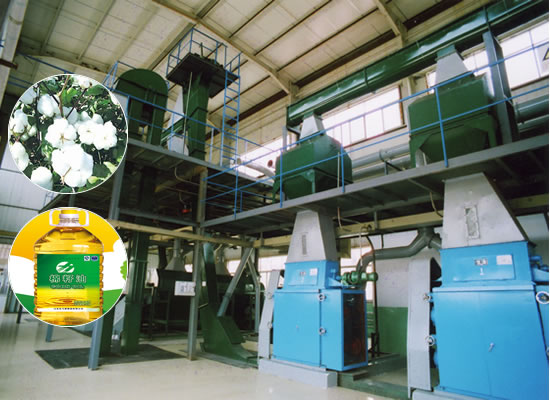
Implementing this flow with data-driven monitoring closes the quality loop effectively.
Don’t leave your product quality to chance. Adopt proven operational control techniques that minimize variation and maximize profitability. Remember, your customers expect consistent clarity, long shelf life, and superior taste — all achievable once you master this process.
 411
|
411
|
 hydraulic oil press
sesame oil pressing temperature
premium sesame oil production
cold pressing oil extraction
oil press comparison
hydraulic oil press
sesame oil pressing temperature
premium sesame oil production
cold pressing oil extraction
oil press comparison
 371
|
sunflower oil extraction methods
physical cold pressing sunflower oil
solvent extraction oil
vitamin E retention in sunflower oil
export grade sunflower oil
371
|
sunflower oil extraction methods
physical cold pressing sunflower oil
solvent extraction oil
vitamin E retention in sunflower oil
export grade sunflower oil
 209
|
Cottonseed Oil Extraction Machinery
Efficient Cottonseed Oil Press
High Capacity Cottonseed Oil Refining Equipment
Automated Cottonseed Oil Extraction
Modern Cottonseed Processing Technology
Cottonseed Oil Production Solutions
Quality Improvement in Cottonseed Oil Extraction
Eco-friendly Cottonseed Oil Processing
Cottonseed Oil Yield Enhancement Equipment
Versatile Cottonseed Oil Machinery
209
|
Cottonseed Oil Extraction Machinery
Efficient Cottonseed Oil Press
High Capacity Cottonseed Oil Refining Equipment
Automated Cottonseed Oil Extraction
Modern Cottonseed Processing Technology
Cottonseed Oil Production Solutions
Quality Improvement in Cottonseed Oil Extraction
Eco-friendly Cottonseed Oil Processing
Cottonseed Oil Yield Enhancement Equipment
Versatile Cottonseed Oil Machinery
 318
|
Leaching and refining equipment
Sesame oil refining process
Six - degreasing process
Solvent recovery technology
High - efficiency oil extraction equipment
318
|
Leaching and refining equipment
Sesame oil refining process
Six - degreasing process
Solvent recovery technology
High - efficiency oil extraction equipment
 246
|
Palm Kernel Oil
Oil Pressing Machinery
Southeast Asian Food Processing
246
|
Palm Kernel Oil
Oil Pressing Machinery
Southeast Asian Food Processing