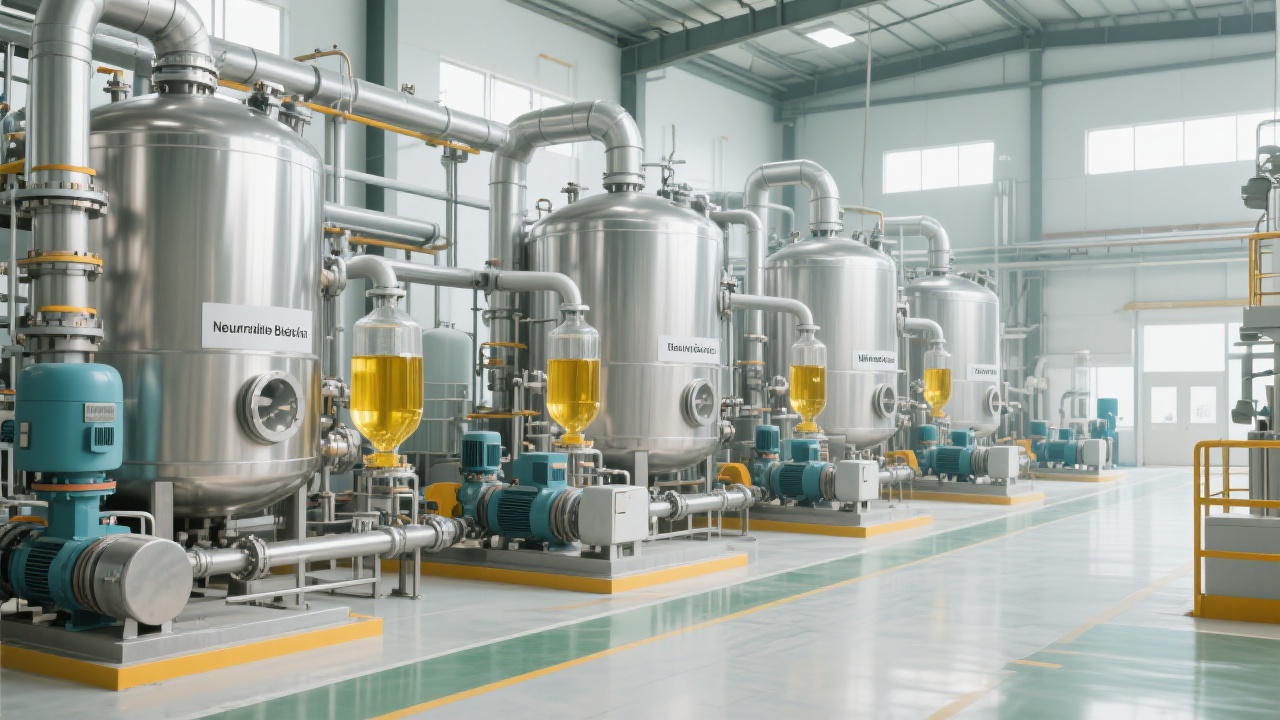
In palm kernel oil production, centrifuges play a crucial role in determining oil purity and residual oil content in the residue. The basic principle of centrifugal separation is the three - phase (oil, water, and solid) stratification mechanism driven by density differences under a rotating force field. As the centrifuge rotates, substances with different densities are separated due to the centrifugal force. For example, in a typical centrifuge, the denser solids move towards the outer edge, while the lighter oil and water form distinct layers in the inner part. This separation process can be better understood with the help of the following illustration:
When it comes to palm kernel oil production, two main types of centrifuges are commonly used: decanter centrifuges and disc centrifuges. Let's compare them in terms of structure design, processing capacity, energy consumption, and maintenance complexity:
| Aspect | Decanter Centrifuge | Disc Centrifuge |
|---|---|---|
| Structure Design | It has a horizontal cylindrical bowl with a screw conveyor inside for continuous solids discharge. | It consists of a stack of conical discs, which provide a large surface area for separation. |
| Processing Capacity | Suitable for large - scale production, with a high throughput of up to 50 - 100 tons per hour in some industrial applications. | Generally more suitable for medium - scale production, with a throughput of around 10 - 50 tons per hour. |
| Energy Consumption | Relatively higher due to the continuous operation of the screw conveyor and the large - scale rotation of the bowl. | Lower energy consumption as it mainly relies on the rotation of the disc stack. |
| Maintenance Complexity | Higher complexity due to the presence of the screw conveyor, which may require more frequent maintenance and replacement of parts. | Relatively lower maintenance complexity, with fewer moving parts. |
Selecting the right centrifuge depends on several factors, including raw material characteristics, production capacity, and product grade:
Three key parameters need to be carefully regulated during the operation of centrifuges: speed, feed rate, and temperature.
One of the common problems in palm kernel oil centrifugation is oil - water emulsification. Here are some causes and prevention measures:
The palm kernel oil centrifugation industry is moving towards intelligent control and energy - saving equipment. Intelligent control systems can automatically adjust the centrifuge's parameters according to the raw material characteristics and production requirements, improving the overall efficiency. Energy - saving equipment not only reduces operating costs but also meets the growing environmental requirements. As an oil mill engineer or technical leader, you should pay attention to these upgrade opportunities to stay competitive in the market.
Q: Which centrifuge is more suitable for small - scale palm kernel oil production?
A: A disc centrifuge is generally more suitable for small - scale production due to its relatively lower processing capacity and energy consumption.
Q: How can I prevent oil - water emulsification during centrifuge operation?
A: You can add demulsifiers and pre - heat the raw material to a suitable temperature. Also, keep the feed rate within the recommended range.
Interested in optimizing your palm kernel oil centrifugation process? Click to get the PDF of 'Palm Kernel Oil Centrifugal Separation Optimization Manual'

 492
|
492
|
 cold pressed sunflower oil production
low temperature oil extraction
premium edible oil processing
sunflower oil cold pressing technology
cold press oil nutrition retention
cold pressed sunflower oil production
low temperature oil extraction
premium edible oil processing
sunflower oil cold pressing technology
cold press oil nutrition retention
 70
|
Sunflower oil pressing
Solution for high oil content in residues
Oil yield efficiency improvement
Physical pressing technology
Edible oil processing technology
70
|
Sunflower oil pressing
Solution for high oil content in residues
Oil yield efficiency improvement
Physical pressing technology
Edible oil processing technology
 183
|
rice bran oil expander
oil yield enhancement technology
rice bran oil extraction process
expander machine parameter settings
rice bran oil production optimization
183
|
rice bran oil expander
oil yield enhancement technology
rice bran oil extraction process
expander machine parameter settings
rice bran oil production optimization
 295
|
Cold - pressed sunflower seed oil production process
Low - temperature pressing technology
High - end edible oil process
Sunflower seed oil equipment selection
Quality inspection indicators
295
|
Cold - pressed sunflower seed oil production process
Low - temperature pressing technology
High - end edible oil process
Sunflower seed oil equipment selection
Quality inspection indicators
 293
|
castor oil extraction
mechanical efficiency
yield enhancement
293
|
castor oil extraction
mechanical efficiency
yield enhancement






.jpg?x-oss-process=image/resize,m_fill,h_300,w_300/format,webp)