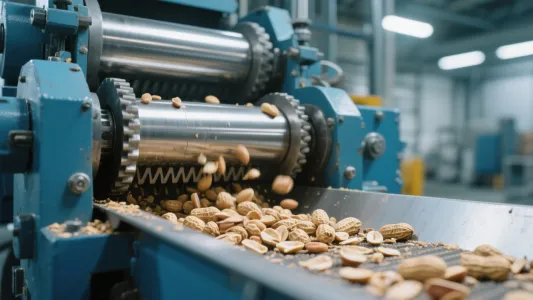
In the palm kernel oil extraction process, the crusher plays a crucial core role. It's the first and key step, directly influencing the subsequent pressing efficiency and oil yield. Without proper crushing, the whole extraction process can be severely affected.
Hammer crushers work by using high - speed rotating hammers to strike the palm kernels. They are suitable for palm kernels with relatively low moisture content and lower hardness. The impact force can break the kernels into smaller pieces effectively. In fact, in scenarios where the moisture content is below 10% and the hardness is relatively low, hammer crushers can achieve a crushing efficiency of up to 80%.
Roller crushers, on the other hand, crush the palm kernels through the pressure between two rotating rollers. They are more suitable for palm kernels with higher moisture content and higher hardness. When dealing with palm kernels with a moisture content of 10% - 15% and higher hardness, roller crushers can ensure a stable crushing process, reducing the equipment wear rate by about 30% compared to hammer crushers.
The crushing granularity has a significant impact on the pressing efficiency, oil yield, and subsequent process blockages. If the granularity is too large, the pressing efficiency will decrease, and the oil yield may be reduced by up to 15%. Moreover, large - sized particles can easily cause blockages in subsequent processes, increasing the downtime of the equipment. On the contrary, if the granularity is too small, it may lead to increased energy consumption and unnecessary wear of the equipment.
Regular lubrication is essential for the smooth operation of the crusher. For most crushers, lubrication should be carried out every 8 - 10 working hours. Using high - quality lubricants can reduce the friction between moving parts, extending the service life of the equipment by about 20%.
Cleaning the crusher regularly can prevent the accumulation of debris and dust, which may cause blockages and corrosion. It is recommended to clean the crusher at least once a week. This simple step can reduce the failure rate by about 15%.
Regularly inspect key components such as hammers, rollers, and bearings. Components with significant wear should be replaced in time. For example, hammers usually need to be replaced every 200 - 300 working hours, while bearings may need replacement every 500 - 600 working hours. This can ensure the stable operation of the equipment and reduce unexpected breakdowns.
Let's take a look at some typical fault cases. For example, if the crusher makes abnormal noises, it may be due to loose parts or uneven wear of hammers. By checking the fastening bolts and replacing worn - out parts, the problem can usually be solved quickly. Another common problem is low crushing efficiency, which may be caused by incorrect granularity settings or worn - out components. Through timely adjustment and replacement, the efficiency can be restored.
To save energy, you can optimize the operating parameters of the crusher according to the actual situation. For example, adjusting the rotation speed of the crusher can reduce energy consumption by about 10% - 15% without affecting the crushing quality. In addition, regular maintenance can also improve the operation stability of the equipment, reducing the downtime and increasing the overall production efficiency.
Do you often encounter blockages in your equipment? Are you worried about high energy consumption and short equipment life? If so, don't hesitate to seek customized solutions.
Get the Crusher Maintenance Self - Check List PDF now to ensure the efficient operation of your crusher!

 171
|
171
|
 custom seed preprocessing solutions
vegetable oil production line
oilseed processing technology
custom seed preprocessing solutions
vegetable oil production line
oilseed processing technology
 65
|
sunflower seed oil pressing process
low oil yield in oil press
high residue oil in cake
physical oil extraction techniques
nutrient retention in cold pressed oil
65
|
sunflower seed oil pressing process
low oil yield in oil press
high residue oil in cake
physical oil extraction techniques
nutrient retention in cold pressed oil
 424
|
oilseed preprocessing equipment
efficient vegetable oil production solutions
comprehensive technical support services
424
|
oilseed preprocessing equipment
efficient vegetable oil production solutions
comprehensive technical support services
 295
|
Cold - pressed sunflower seed oil production process
Low - temperature pressing technology
High - end edible oil process
Sunflower seed oil equipment selection
Quality inspection indicators
295
|
Cold - pressed sunflower seed oil production process
Low - temperature pressing technology
High - end edible oil process
Sunflower seed oil equipment selection
Quality inspection indicators
 211
|
palm kernel oil purification
centrifugal separation technology
centrifuge speed control
feed rate optimization
temperature regulation
211
|
palm kernel oil purification
centrifugal separation technology
centrifuge speed control
feed rate optimization
temperature regulation